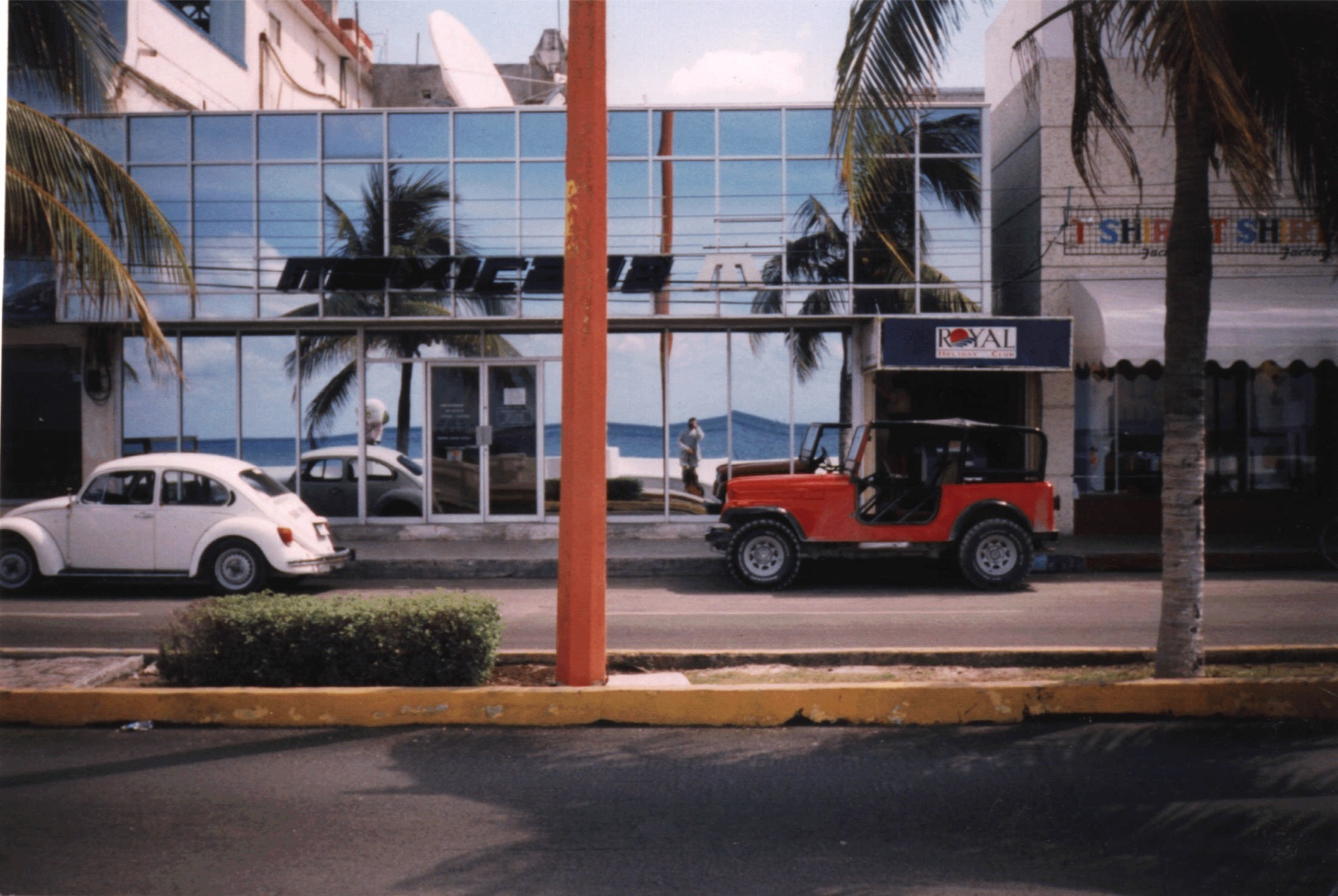
First, the location.
The wider photograph shows the setting: a glass-fronted building facing the road and sea, with palm trees reflected across its façade.
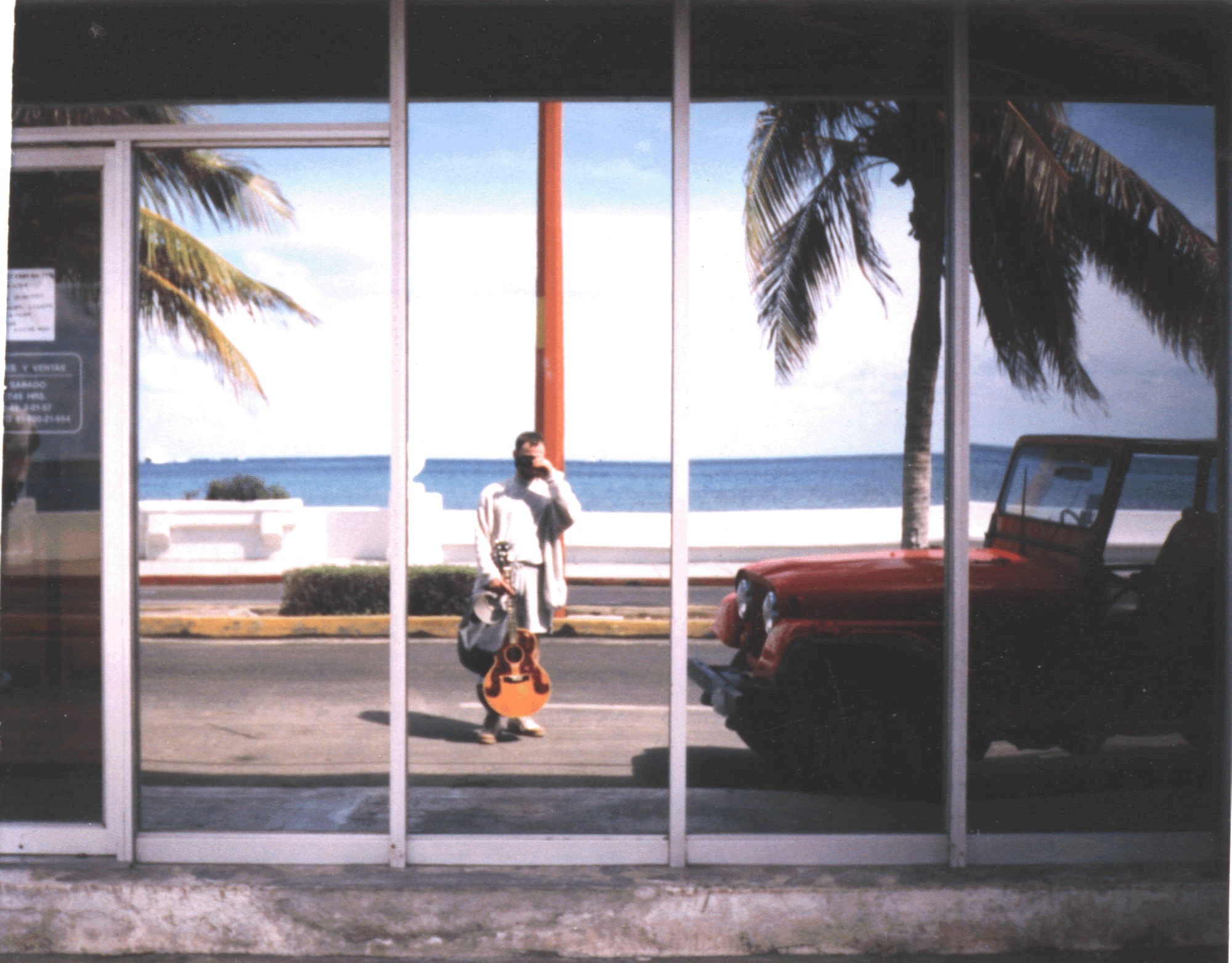
Move closer and the glass stops being merely a building. It becomes the frame for another photograph.
Paul. Guitar. Sea. Palm trees. Red Jeep.
The closer photograph from that Cozumel sequence is the one that mattered.
Paul stands outside with the guitar, seen through the divisions of the glass frontage. Behind him are the sea, a palm tree and the red Jeep. The architecture divides the image almost like a ready-made sleeve design.
This was the photograph later used as artwork for a CD Paul made for a friend.
The CD needed a title.
THE TITLE WAS
I'M BETTER NOW
It was sarcastic.
The joke is in how confidently it says it.
I'm Better Now has the shape of a conclusion: problem solved, crisis passed, everything fine.
But the title was deliberately sarcastic. That tension is what gave it life — and perhaps why the phrase refused to disappear afterwards.
It wasn't merely a label attached to one homemade CD. It became one of those phrases that has cropped up here and there through Paul's musical history.
Holiday photograph.
CD artwork.
Archive artefact.
The photograph wasn't taken with a CD sleeve in mind. But its glass divisions, guitar, sea and strong blocks of colour already give it the structure of artwork. Its later use gave it a new identity.
Years later again, recovering the photograph reconnects the image with the title and the story behind it.
That is one of the pleasures of an archive: objects acquire histories of their own.
Some titles finish a project.
Others keep following you around.
I'm Better Now belongs to the second category. The phrase has resurfaced at different points in Paul's musical history, carrying a little of the original joke with it each time.
As more of that history is recovered, those later appearances can be connected back here rather than treated as unrelated fragments.
“I'M BETTER NOW.”
Well... that was the title, anyway.