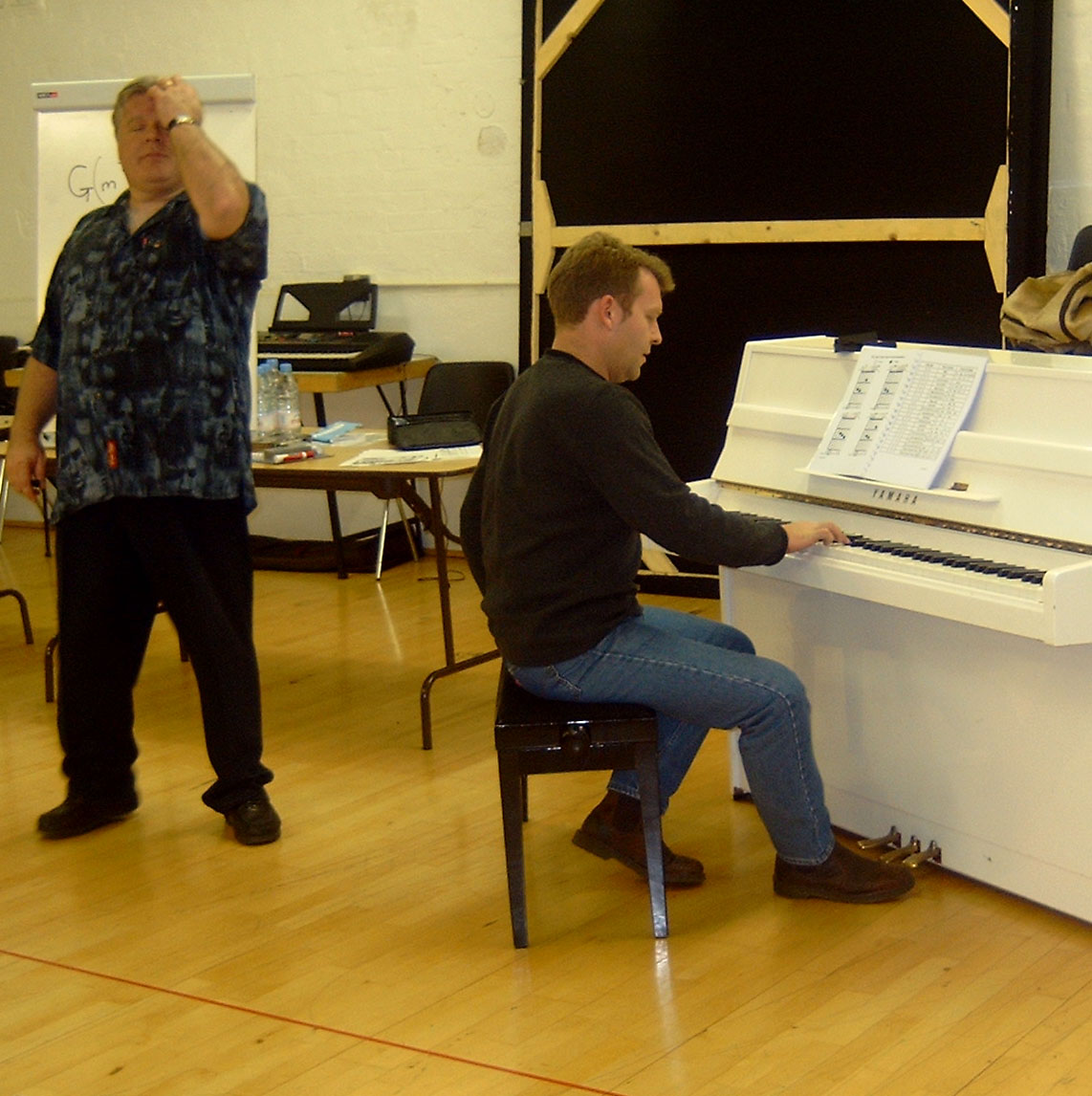
First, we went to Duncan.
In 2002 my wife and I travelled to America for Duncan Lorien's seminars. A Cruse Control newsletter written at the time records that I had flown to America twice that year and completed both the Understanding of Music and Understanding of Songwriting seminars.
My recollection of the songwriting trip is much less corporate. We stayed at Duncan's waterfront home near Boston. The tide actually came in underneath the property. From the balcony you could walk down the steps to paddle or swim when the tide was in — or walk the beach when it was out.
Then we brought the idea home.
A database company starts selling music seminars.
It sounds slightly improbable now, but it was real. Cruse Control had begun as a creative business before databases became its main direction. In the Christmas 2002 issue of Good Control, the company described the Understanding of Music seminar as a way of bringing itself back towards its creative roots.
Cruse Control promoted and sold places for the London seminars alongside CONTACTS!, WorkflowPLUS!, consultancy, design and the rest of the business. The first London Understanding of Music weekend was held at the English Touring Theatre, 25 Short Street, Waterloo, on 10–12 January 2003.
The surviving first-event flyer names Micky Simantov — Nitsan Simantov's mother — as a booking contact. Micky has since passed away. By the return event in July, Helen Cruse was the listed booking contact.
Music had wandered right into the middle of Cruse Control.
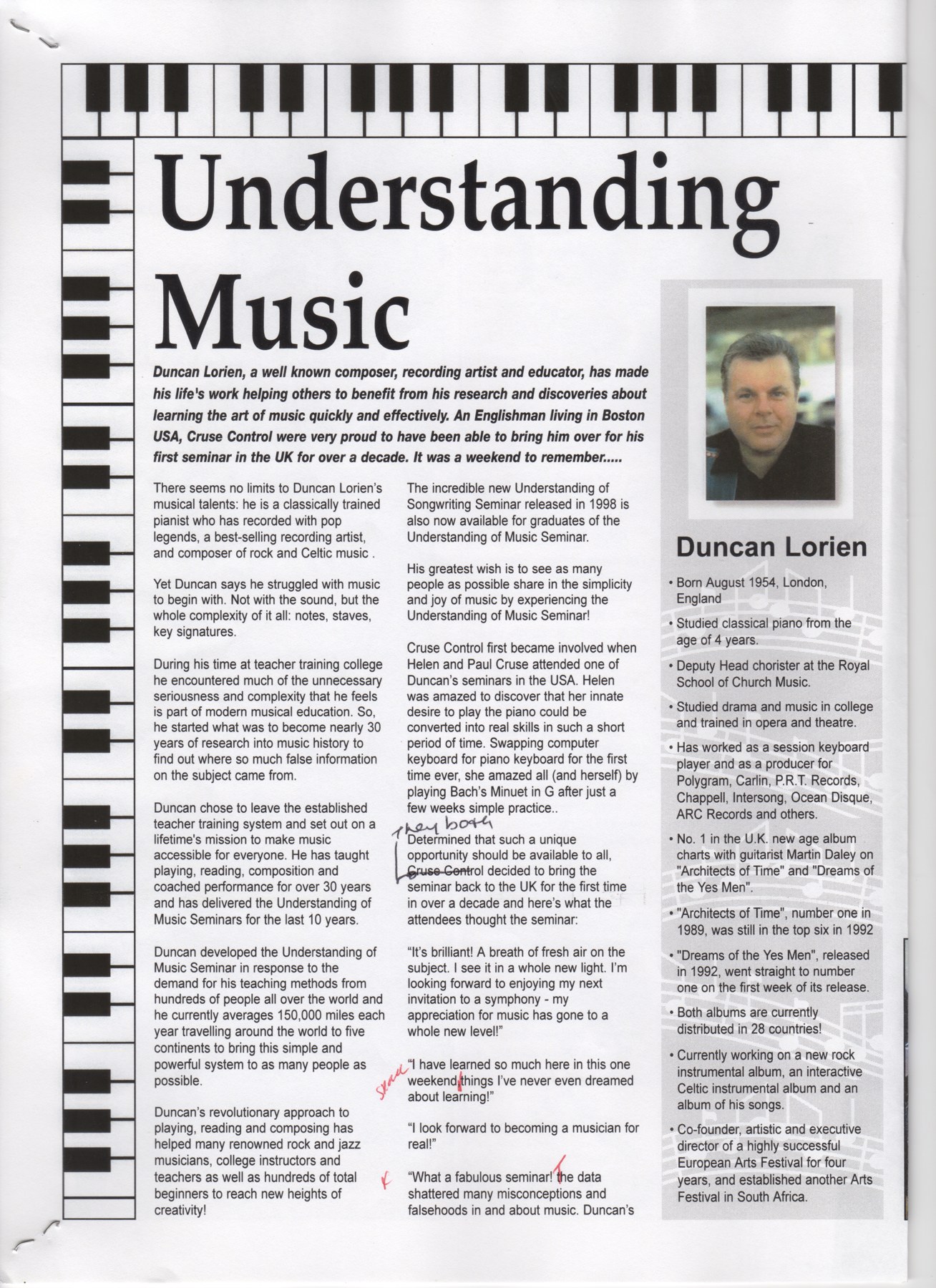
And then Duncan came back.
The January event was followed by another Understanding of Music seminar at the same Waterloo venue on 18–20 July 2003. The surviving information pack calls it Duncan Lorien coming “BACK to London” and includes success stories from the January seminar.
The course material promised to demystify scales, modes, chords, inversions, notation and sight reading. The songwriting material went further: melody rules, song structure, modulation, chord substitutions, writing in different styles and what it called “Eight basic agreements that harmony is based upon.”
Cruse Control's surviving material says its administration of the seminars would pass to a new administrator after August 2003. For a short period, though, this unlikely crossover between the database company and its creative past was very real.
Then I tried one of Duncan's ideas.
Eights.
I remember Duncan explaining a musical relationship involving an augmented chord — possibly C augmented — and a way of improvising around it so that apparently almost any note you played would remain musically compatible. I also remember an association with “eights” or eighths.
I don't now trust myself to reconstruct the precise theory from memory, so I won't.
What I do remember is trying it.
It worked. Eights was born.
The surviving seminar syllabus independently documents Duncan teaching eight basic agreements underlying harmony, along with melody and chord techniques. Whether that is the exact origin of the title Eights remains a recollection rather than something the paperwork proves.
The recording survived for years on the Cruse Control server under an old and uncertain “Unknown Artists” presentation. In 2026 it was identified as my work and brought back into the Paul Cruse Music archive.
This one left evidence everywhere.
Old web pages. Seminar flyers. Information packs. Photographs. A Cruse Control office noticeboard. Good Control newsletters. A stapled, corrected working draft of the post-event feature. And finally the MP3 itself.
Some details come from contemporary documents. Others — Duncan's waterfront home, the tide beneath the property, and the particular musical experiment that led to Eights — are my recollections.
Where the two don't tell us something, the archive doesn't invent it.
Paper. Memory. Music. Twenty-odd years later, they meet again.